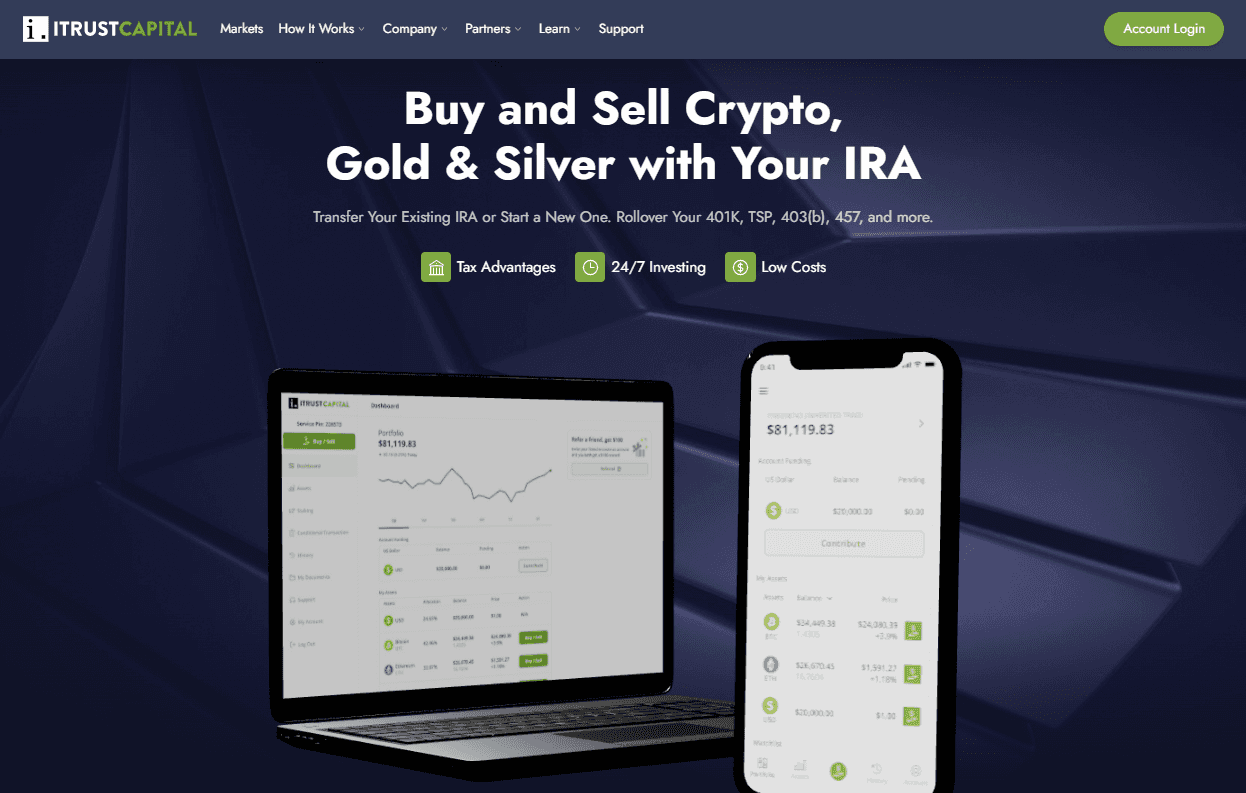
iTrustCapital Wallet –
iTrustCapital has become a notable platform in the U.S. for investors seeking cryptocurrency and precious metals exposure through regulated accounts. While it markets itself as a “wallet,” it is technically not a self-custody crypto wallet. Instead, iTrustCapital provides institutional custody solutions, allowing users to trade and store assets securely within tax-advantaged or taxable accounts.
This guide explores what iTrustCapital is, how it works, account types, security, fees, pros and cons, and alternatives to help investors make informed decisions.
1. What is iTrustCapital?
iTrustCapital is a financial technology platform that allows U.S. investors to:
Buy, hold, and sell cryptocurrencies.
Invest in precious metals like gold and silver.
Use self-directed IRAs for tax-advantaged crypto and metal investments.
Unlike traditional wallets where users control private keys, iTrustCapital holds assets in institutional custody. The platform acts as a bridge between the user and the custodian, providing a secure and regulated interface.
Key Point: iTrustCapital is primarily for long-term investment and retirement planning, not for sending crypto to friends or DeFi applications.
2. How iTrustCapital Works
2.1 Account Types
Crypto IRA (Self-Directed IRA)
Designed for retirement investments.
Allows users to buy and hold crypto and metals under a tax-advantaged structure.
Assets are held by a qualified custodian, ensuring compliance with IRS rules.
Distribution rules apply: withdrawals usually occur after age 59½, with potential penalties for early withdrawal.
Premium Custody Account (PCA)
Taxable account for crypto and metals.
Deposits are made in USD, and crypto trades occur within the platform.
Withdrawals are usually in USD; direct transfers of crypto to external wallets are limited.
Ideal for investors who want secure custody without self-custody risks.
2.2 Trading and Investing
iTrustCapital allows buying and selling cryptocurrencies like Bitcoin, Ethereum, and other supported coins.
Trades are executed within the platform, with real-time pricing and institutional-grade custody.
Users can track investments, view balances, and monitor performance via web dashboards or mobile apps.
3. Security Features
iTrustCapital emphasizes security through custody and regulatory compliance:
Assets are held by institutional custodians (cold storage, MPC, and other advanced security measures).
Custody accounts are segregated from iTrustCapital’s operating funds.
Two-factor authentication (2FA) protects account access.
Insurance coverage exists via custodians for certain assets, though coverage limits apply.
Additional verification steps, like identity checks and KYC procedures, are enforced during onboarding.
Important: Unlike self-custody wallets, users do not control private keys directly. Security depends on both iTrustCapital’s custodians and user account practices.
4. Fees
iTrustCapital charges a transparent fee structure:
Transaction fee: 1% per crypto purchase or sale.
No monthly or setup fees for PCA accounts.
IRA account fees: Account maintenance may vary depending on custodian agreements.
Fees are higher than self-custody wallets, but the tradeoff is institutional-grade security and IRS compliance.
5. Pros and Cons
Pros
Secure custody of crypto and precious metals.
U.S.-regulated platform with tax-advantaged IRA options.
Easy-to-use web and mobile interface.
Integrates crypto and precious metals under one account.
Reduces risk of private key loss or theft.
Cons
Users cannot freely withdraw crypto to external wallets (except in certain IRA distributions).
U.S. residents only — international access is limited.
1% transaction fees can add up for frequent traders.
Not suitable for active trading, DeFi, or direct wallet-to-wallet transfers.
6. Alternatives to iTrustCapital
If you want full control of crypto, alternatives include:
Ledger / Trezor Hardware Wallets – Non-custodial, offline storage for private keys.
MetaMask – Software wallet for Ethereum and EVM chains with DeFi and NFT support.
Trust Wallet – Multi-chain mobile wallet with full control over private keys.
Coinbase Wallet – Non-custodial, mobile-friendly wallet for crypto storage and dApps.
iTrustCapital is best for investors prioritizing security, IRA compliance, and long-term holding rather than flexibility or frequent trading.
7. Who Should Use iTrustCapital?
iTrustCapital is ideal for:
U.S.-based investors seeking tax-advantaged crypto exposure.
Individuals who prefer custodial storage over self-custody.
Investors looking to combine crypto and precious metals in one platform.
Those focused on long-term growth and retirement planning.
Not ideal for:
Traders needing frequent withdrawals or external wallet transfers.
International users outside the U.S.
Users wanting full private key control.
8. Conclusion
iTrustCapital is a secure, regulated platform for crypto and precious metals investment. While it does not function as a self-custody wallet, it provides a user-friendly interface, institutional custody, and IRS-compliant account structures, making it a strong choice for U.S. investors focusing on long-term holding or retirement accounts.
Remember: iTrustCapital is a custody-focused platform. If you want full control of your crypto with the ability to send assets freely, a traditional non-custodial wallet is a better choice.